

20 Car Organization Ideas That Keep Your Car Clean Without Trying
This is inside the car, $15–$50. Start by emptying it completely.
Empty the car, sort what comes out into keep, home and trash, then give every kept item a zone: trunk bins, a console insert, a seat-back organizer, and a glove box that holds registration, insurance and the manual — nothing else. Two or three labelled collapsible bins do the trunk: groceries and emergency gear, on a non-slip mat, with heavy items low and against the back seats. Measure the trunk before you buy, and pick a collapsible organizer with adjustable dividers and a non-slip bottom — the best one stays put when you corner. The back seat gets a seat-back organizer with a tablet sleeve and a lidded trash can, emptied at every gas stop. The habit is the exit tidy rule: everything that does not belong in the car leaves the car every time you get out. A reset takes 30 minutes; keeping it takes 2 minutes a day.
My car used to be a second junk drawer on wheels: snack wrappers in the door pockets, toys under the seats, cables everywhere, and a trunk I was afraid to open. It did not get messy all at once — it got messy one “I will deal with it later” at a time.
These car organization ideas are the system that finally broke that cycle in my car: every category of car stuff now has a place, and keeping it clean takes minutes instead of a weekend deep-clean.
A car is a small space that works hard, a bit like a garage on wheels — and the same zone principle applies. If your garage needs the same treatment, my garage organization ideas use the same approach for a bigger space. Here, we focus on the car itself.
The 20 ideas cover the trunk, the back seat, and every pocket in between: zoned bins, a seat-back organizer for kids, a console tray, a fixed home for the umbrella, and a five-minute weekly reset. Every idea lists its honest cost, time, and difficulty, so I start with the mess I notice every time I drive.
Key Takeaways
- Zone the car like a room: trunk, console, doors, and backseat each get their own job.
- Contain small items or they will spread — trays, pouches, and bins beat loose storage every time.
- Kids’ stuff needs its own system, or it will colonize the whole backseat.
- Build trash and reset habits into driving, or no organizer will save you.
- Keep only daily essentials in the car; everything else lives in the house or garage.
20 Car Organization Ideas for Families, Commuters, and Road Trips
1. Divide the Trunk Into Zones With Bins

An undivided trunk is where groceries slide, sports gear migrates, and emergency supplies vanish. I put two small bins in our trunk: one for the permanent residents (emergency kit, jumper cables, reusable bags) and one for the current load (groceries, library books, returns). Everything else stays out.
The bins stop sliding with a strip of non-slip mat underneath, and because each bin has a job, I can see at a glance what belongs and what is just riding around for no reason. A trunk with zones loads and unloads in half the time.
Trunk bins are baskets by another name — the organize with baskets guide runs the same bin system for the house.
AutoZone’s guide starts the same way: pull everything out of the car before buying a single organizer, then zone the trunk, back seat, glove box and console — and empty the small trash can every time you stop for gas.
Pro Tip: I keep the trunk bin I use most nearest the trunk opening, since a bin buried behind two others never gets used.
Cost: $10-20 for bins and a non-slip mat. Time: 15 minutes to sort and place. Difficulty: Easy.
2. Hang a Seat-Back Organizer for the Kids

Kids’ car stuff used to live on the floor, under seats, and wedged between cushions. A seat-back organizer — the kind that straps to the front seat with pockets facing the back — gave all of it a home: books, crayons, a water bottle, snacks, and a tablet, each in its own pocket.
The kids can reach their own things without asking me, and cleanup is just checking the pockets. The same one-home logic works for toys at home too — my guide to organizing children’s toys uses the same pocket-and-zone thinking — and the car version is where it matters most, because a messy backseat is also a distracting one.
Pro Tip: I keep the seat-back organizer’s pockets for quiet activities only, because noisy toys in a car organizer defeat the purpose.
Cost: $15-30 for a seat-back organizer. Time: 10 minutes to hang and load. Difficulty: Easy.
3. Drop a Tray Into the Center Console

Center consoles are deep, dark pits where phones, change, and lip balm go to hide. A simple tray insert that sits at the top of the console changed ours completely: daily items live in the tray where I can see them, and rarely-used things sink to the bottom compartment where they belong.
I keep only five things in the tray — phone cable, change, a pen, mints, and one charging adapter — and everything else is banned. Small items need small containers; my small-item organization approach is the same idea, just sized for a car.
The tray holds one phone cable and one charging adapter — nothing else — and the organize cables guide keeps the rest of the cords from ever reaching the car.
Pro Tip: I empty the console tray every time I fill up with fuel, since a tray that never empties becomes a junk drawer.
Cost: $8-15 for a console tray. Time: 5 minutes to drop in and sort. Difficulty: Easy.
4. Fill the Seat Gap With a Slim Pocket

The gap between the seat and the console eats phones, keys, and cards — I have fished my phone out of that canyon more times than I care to admit. A slim seat-gap pocket slides into that space and turns it into storage for a phone, a pen, and a few cards, right where your hand naturally goes.
It also blocks things from falling in the first place, which is the real win. Measure your gap before buying, because seats and consoles vary, and a pocket that is too thick will not fit or will push the seat out of position.
Keys, the garage opener and the toll card live in the seat-gap pocket now — the key storage ideas guide gives each of them a fixed home at the house end too.
Pro Tip: I keep the seat-gap pocket for my phone and wallet only, because a pocket that holds everything holds nothing I can find.
Cost: $10-20 for a pair of gap pockets. Time: 2 minutes to slide in. Difficulty: Easy.
5. Hang Bags From Headrest Carabiners
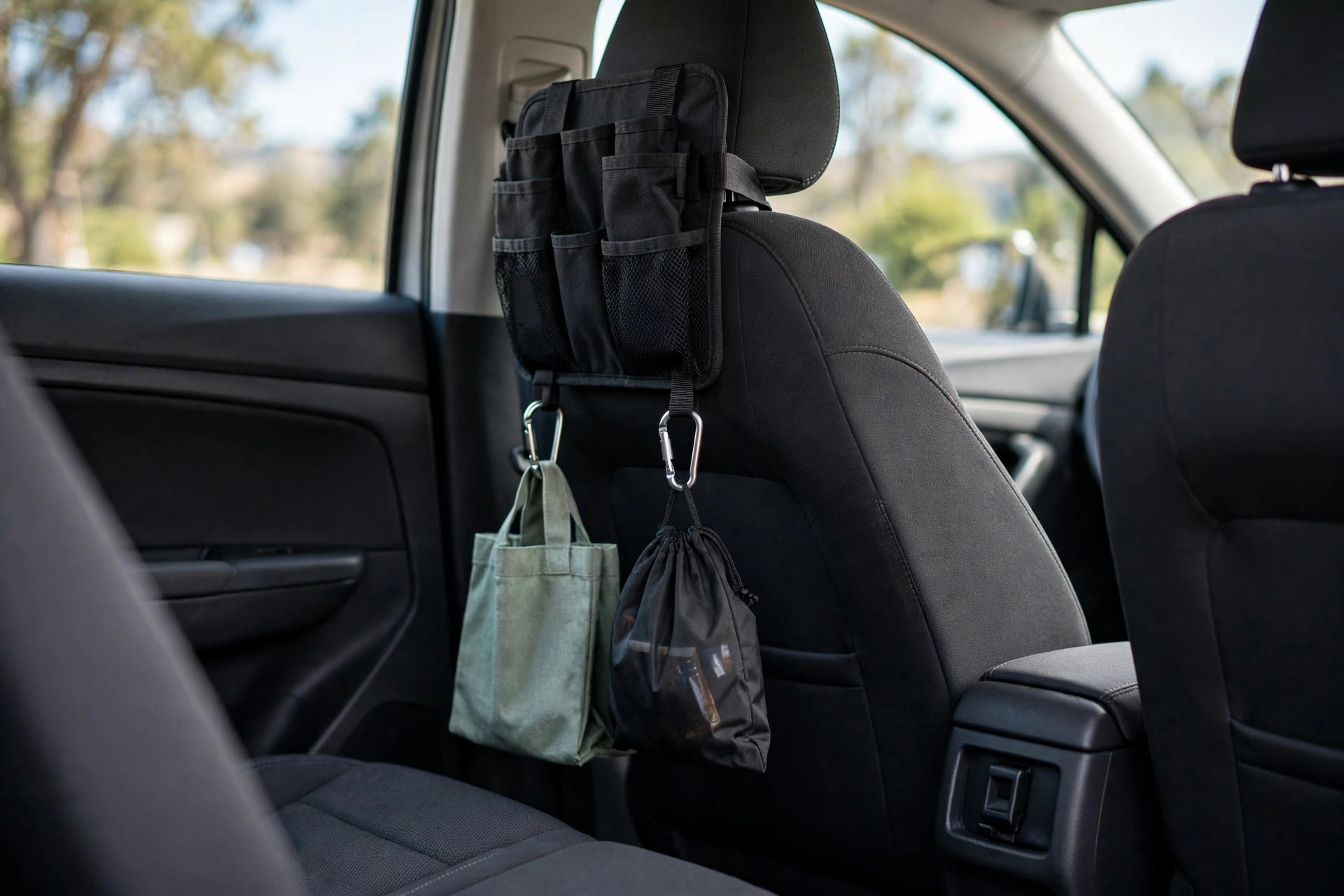
Purses, grocery bags, and gym bags sliding around the backseat are annoying and, in a sudden stop, genuinely unsafe. I clip large carabiners around the front headrest posts, and bags hang from them instead of rolling around. Groceries stay upright, my purse stays off the floor, and the backseat stays clear for passengers.
Use sturdy climbing-style carabiners, not flimsy keychain ones, and keep the hanging weight reasonable — this is for bags, not for luggage.
Pro Tip: I hang bags from carabiners only when parked, since swinging bags while driving distract me.
Cost: $5-10 for carabiners. Time: 2 minutes to clip on. Difficulty: Easy.
6. Clip Sunglasses to the Visor

Sunglasses used to live in the cup holder, the console, or the door pocket, and I scratched two pairs before I fixed it. A simple visor clip — or a binder clip on the visor in a pinch — holds them exactly where you reach when the sun hits.
One pair lives on the visor permanently, and a spare pair lives in the glovebox in a hard case. Sunglasses are small, expensive, and easy to lose in a car, so giving them a dedicated spot pays for itself the first time you do not have to replace a scratched pair.
Pro Tip: I clip sunglasses to the visor I use least, because the visor I flip down daily knocks the clip off.
Cost: $3-8 for a visor clip, or free with a binder clip. Time: 1 minute. Difficulty: Easy.
7. Line Cup Holders With Silicone Cups

Cup holders collect sticky residue, crumbs, and mystery grime, and cleaning them is miserable because you cannot reach the bottom properly. I dropped silicone muffin cups into each holder, and now the grime collects in the cup instead. When one gets dirty, I pull it out, rinse it, and drop it back — thirty seconds instead of a scrubbing session.
It is a tiny, silly-sounding fix, and it is one of the most satisfying ones on this list.
Pro Tip: I pull the silicone cups out and rinse them weekly, since a cup that never gets cleaned collects crumbs and spills.
Cost: $3-6 for silicone cups. Time: 1 minute. Difficulty: Easy.
8. Turn a Spare Cup Holder Into a Tissue Dispenser
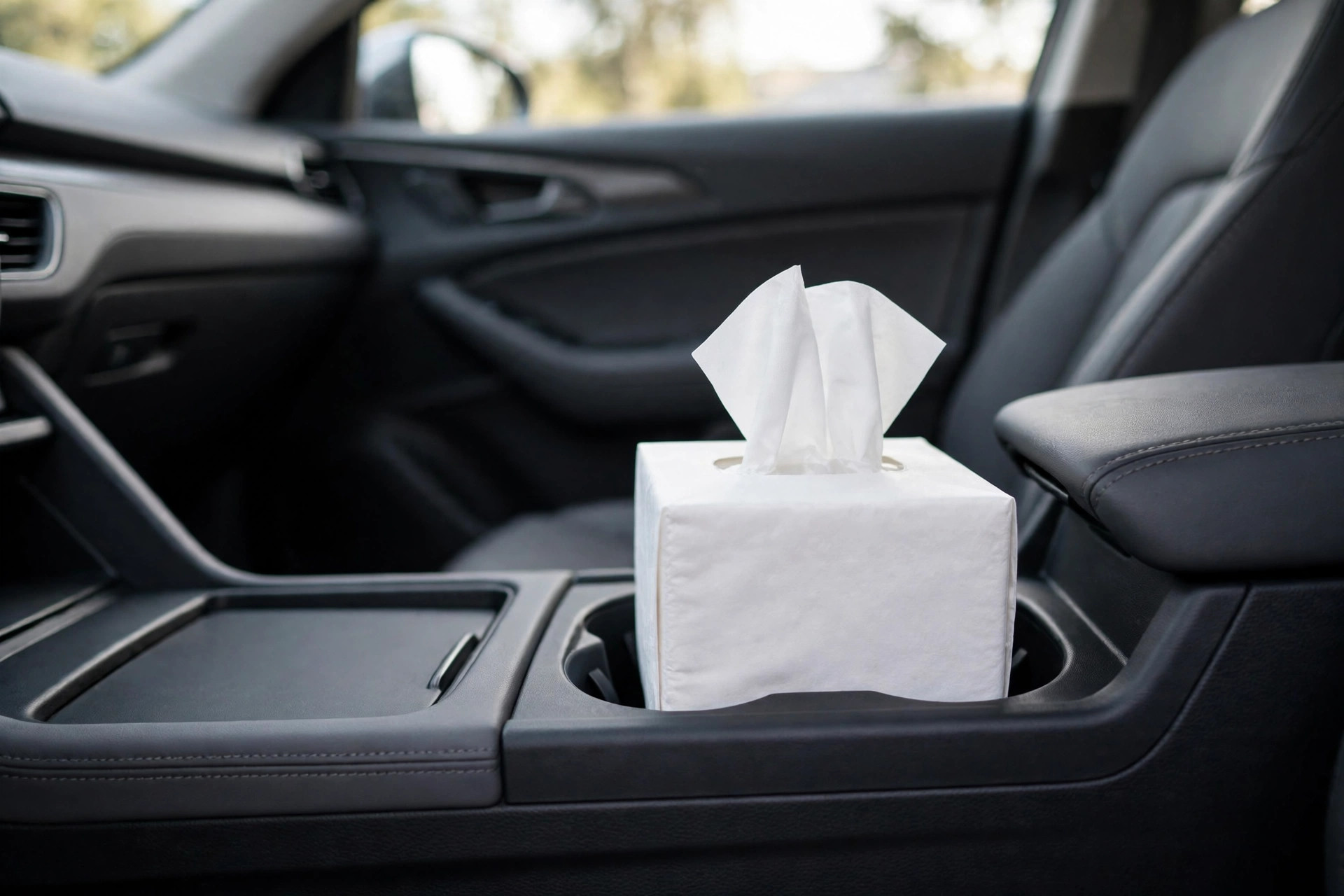
Someone in our car always needs a tissue, and the box used to slide around the backseat. A slim tissue holder designed for a cup holder — or a small pack tucked into an empty holder — keeps tissues exactly where hands can reach them.
It is a small comfort, but on road trips with kids, it is the difference between a quick wipe and a full backseat rummage. Refill it when you do the weekly reset, and it never runs out at the worst moment.
Pro Tip: I keep the tissue pack in the cup holder nearest the driver, because tissues in the back seat help no one sneezing up front.
Cost: $3-8 for a holder, or free with a travel pack. Time: 1 minute. Difficulty: Easy.
9. Keep Car Documents in One Folder

Registration, insurance, and emergency numbers should never be a glovebox treasure hunt. I keep them in one slim folder in the glovebox, in this order: registration, insurance card, emergency contacts, and a pen. If I ever need them — a traffic stop, an accident, a rental return — I hand over the folder instead of digging.
Check the folder twice a year for expired cards, because an organized folder with last year’s insurance is worse than useless.
Pro Tip: I check the documents folder every year when registration renews, so expired papers never sit beside current ones.
Cost: $2-5 for a folder. Time: 10 minutes to assemble. Difficulty: Easy.
10. Pack a Snack Box for Kids

Loose snacks in a car become crumbs in every crevice. A small lidded box — one per kid, or one shared — holds snacks, wipes, and a water bottle in one contained unit that rides in the footwell or on the seat. The lid matters: it keeps crumbs in and stops the box from becoming a second trash can.
We refill the box before long drives and empty it after, which takes two minutes and keeps the backseat from slowly turning into a pantry.
Pro Tip: I pack the snack box the night before a trip, since morning packing means forgotten snacks and hungry kids.
Cost: $5-10 for lidded boxes. Time: 5 minutes to pack. Difficulty: Easy.
11. Clip Travel Pouches Together on a Ring

First aid, medicines, sunscreen, and small activity kits each fit in a clear zip pouch, and a big ring clips the pouches together into one grab-and-go bundle. The bundle lives in a door pocket or seat-back pocket, and I can pull the whole thing out for a picnic or hand one pouch to a kid without unpacking everything.
Clear pouches matter — you can see what is inside without opening five bags. Label each pouch, because identical clear bags all look the same after a month.
Pro Tip: I clip pouches in the order I need them on the ring, so the first pouch I need is the first one I unclip.
Cost: $5-10 for pouches and a ring. Time: 20 minutes to sort and pack. Difficulty: Easy.
12. Stop Grocery Slides With a Bungee or Hooks
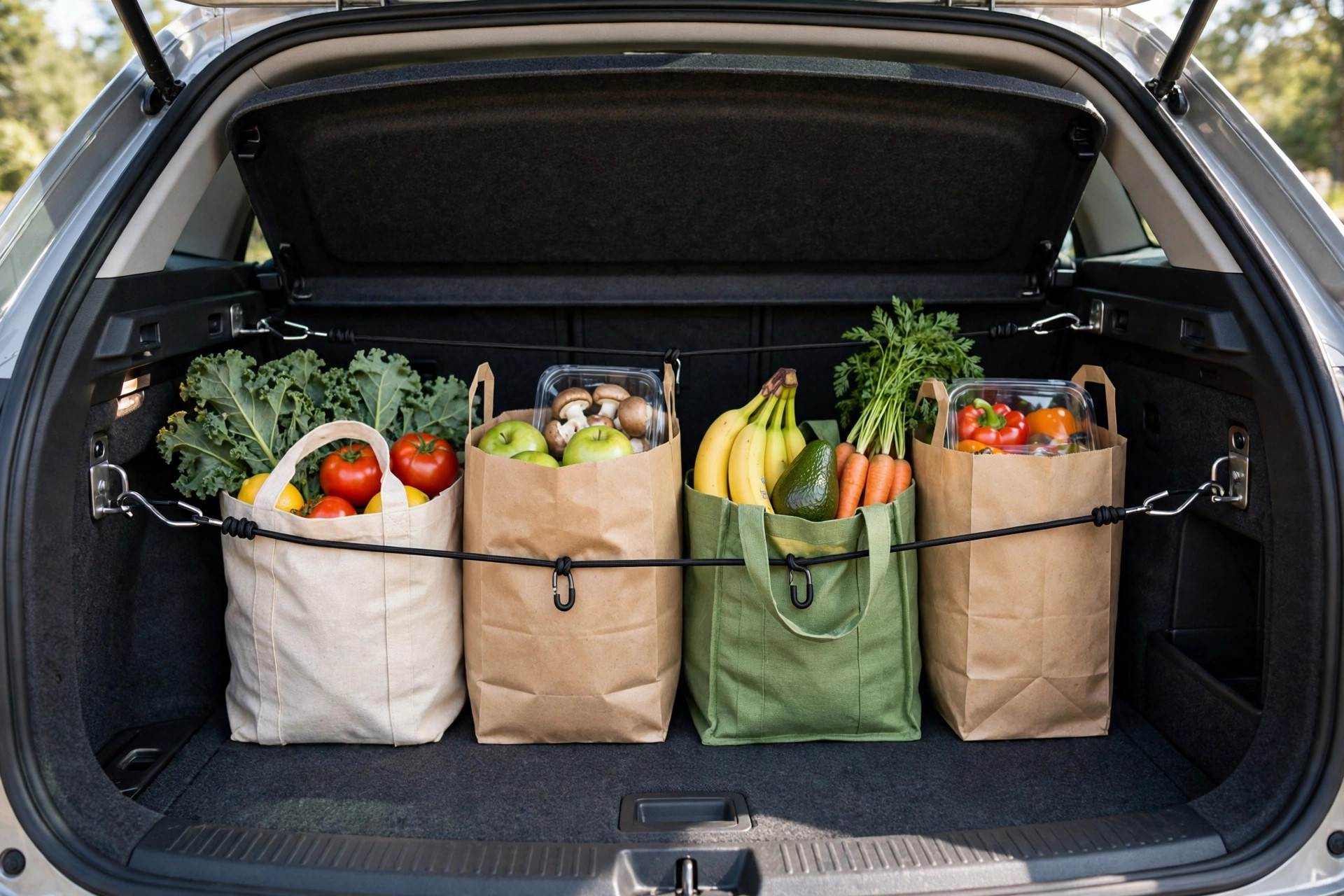
Nothing is more annoying than arriving home to find the eggs under a bag of cans. I string a bungee cord across the trunk and clip grocery bags to it, or hang bags from trunk hooks when the car has them. Either way, bags stay upright and separated instead of sliding into one pile.
This pairs with the trunk bins from idea one: bins for structure, bungee for the bags that do not fit in bins. Ten seconds of clipping saves a crushed loaf of bread.
Pro Tip: I hook grocery bags before I start driving, not after the first turn, because the first turn is when bags slide.
Cost: $3-8 for a bungee cord. Time: 5 minutes to install. Difficulty: Easy.
13. Give Backseat Books Their Own Pocket

Books and activity pads are the best car entertainment and the worst car clutter, because they slide off seats and end up underfoot. A seat-back pocket or a slim magazine holder between the seats gives them a fixed home.
We keep three books and one activity pad per kid in the pocket, and when a book is finished it goes back in the house before a new one comes out. The one-in, one-out rule for car books is strict, because backseat space is the scarcest space in the car.
Pro Tip: I keep backseat books in a pocket kids can reach themselves, since a book pocket adults control is a pocket kids ignore.
Cost: Free with a seat-back pocket, or $5-10 for a holder. Time: 10 minutes. Difficulty: Easy.
14. Enforce a Glovebox Essentials-Only Rule

The glovebox is where car clutter goes to breed: old napkins, expired coupons, three pens, and a manual nobody reads. I emptied ours completely, then allowed back only five things: the documents folder, the car manual, a flashlight, a tire gauge, and a pen. Everything else is banned.
The glovebox stays usable, and I can actually find the manual when a warning light comes on. Empty it twice a year, because gloveboxes refill themselves by some law of nature.
Pro Tip: I clean the glovebox every time I get an oil change, because a glovebox tied to a routine never gets forgotten.
Cost: Free. Time: 15 minutes to empty and restock. Difficulty: Easy.
15. Zone Each Door Pocket

Door pockets are small, so they should hold small, specific things — and only those things. Ours are zoned: driver’s door holds the ice scraper and a microfiber cloth, passenger door holds wipes and a pen, and the back doors hold one water bottle each.
When a pocket starts collecting random items, that is the signal to empty it during the weekly reset. Zoned pockets mean you reach for the right door without thinking, and nothing rattles around in a pocket full of mystery objects.
Pro Tip: I keep each door pocket for one category, since a door pocket that holds everything is a pocket that holds nothing findable.
Cost: Free. Time: 10 minutes to sort and assign. Difficulty: Easy.
16. Give the Umbrella a Fixed Home

Umbrellas are either exactly where you need them or completely forgotten, and the difference is whether they have a fixed spot. Ours lives in the driver’s door pocket, always, rain or shine, and it has saved us more times than I can count.
If your door pocket is too small, a seat-back pocket or a slim umbrella holder clipped to the headrest works just as well. The rule is simple: the umbrella never comes into the house, so it is always in the car when the sky opens up.
Pro Tip: I keep the umbrella in the door pocket nearest the driver, because rain never waits for me to walk around the car.
Cost: Free, or $5-10 for a holder. Time: 2 minutes to place. Difficulty: Easy.
17. Install a Tiny Trash System

A car without a trash plan becomes a trash can, slowly. Ours has a small lidded bin that hangs from a headrest, plus a rule: trash goes in the bin or it waits until we are home — never on the floor, never in a door pocket.
The bin gets emptied at every fuel stop, which takes ten seconds and prevents the slow accumulation that turns into a weekend cleanout. A lidded bin matters, because an open bag of car trash tips over on the first sharp turn.
Pro Tip: I empty the car trash system every time I stop for fuel, since trash that stays in a car becomes a smell.
Cost: $5-12 for a hanging car bin. Time: 5 minutes to hang. Difficulty: Easy.
18. Bolt Down a Real Emergency Kit Box

An emergency kit that slides around the trunk is not much of a kit when you need it fast. Ours lives in a lidded box strapped to a trunk tie-down point, packed with jumper cables, a flashlight, a first-aid kit, a blanket, and water.
It never moves, never gets buried under groceries, and I check it twice a year for dead batteries and expired supplies. Strapping it down is the difference between emergency gear and trunk clutter, and it costs nothing but a strap and a decision.
Pro Tip: I check the emergency kit box every season, because a kit with expired supplies is barely a kit.
Cost: $10-20 for a box and strap, plus kit contents. Time: 30 minutes to pack and strap. Difficulty: Easy.
19. Move Trip Gear to a Roof Carrier

On family road trips, luggage used to eat the whole trunk and half the backseat. A roof cargo carrier moved the bulky, rarely-needed bags upstairs, and suddenly the trunk held only what we needed at stops, and the backseat belonged to the kids again.
Rent one before buying if you only road-trip once a year — many auto shops rent carriers by the week. Pack soft bags up top and keep valuables and snacks inside the car, and check the carrier’s weight limit before loading it.
Pro Tip: I load the roof carrier the night before a trip, since morning loading in the dark means forgotten gear.
Cost: $150-300 to buy, or $30-60 a week to rent. Time: 20 minutes to mount. Difficulty: Moderate.
20. Run a Five-Minute Weekly Car Reset

Every organizer on this list fails without a reset habit, because cars accumulate clutter daily. Mine takes five minutes every Sunday: trash out, loose items back to their zones, trunk bins checked, and a quick wipe of the dashboard. That is it.
Five minutes weekly beats two hours monthly, and the car never reaches the state where cleaning feels like a project. Pair it with fueling up or grocery day so it becomes part of a routine you already have, and the car stays clean almost by itself.
Pro Tip: I run the car reset on the same day I do laundry, so the habit has a built-in reminder.
Cost: Free. Time: 5 minutes weekly. Difficulty: Easy, once it is a habit.
Car Organization Ideas at a Glance
| Idea | Best For | Cost | Time |
|---|---|---|---|
| Trunk bins | Trunk chaos | $10-20 | 15 minutes |
| Seat-back organizer | Kids’ stuff | $15-30 | 10 minutes |
| Console tray | Small items | $8-15 | 5 minutes |
| Seat-gap pocket | Phones, cards | $10-20 | 2 minutes |
| Headrest carabiners | Bags | $5-10 | 2 minutes |
| Visor sunglasses clip | Sunglasses | $3-8 | 1 minute |
| Cup holder liners | Sticky holders | $3-6 | 1 minute |
| Tissue holder | Road trips | $3-8 | 1 minute |
| Documents folder | Paperwork | $2-5 | 10 minutes |
| Snack box | Kids’ snacks | $5-10 | 5 minutes |
| Travel pouches | Small kits | $5-10 | 20 minutes |
| Bungee for groceries | Sliding bags | $3-8 | 5 minutes |
| Book pocket | Backseat books | Free-$10 | 10 minutes |
| Glovebox rule | Glovebox clutter | Free | 15 minutes |
| Door pocket zones | Small items | Free | 10 minutes |
| Umbrella home | Rain readiness | Free-$10 | 2 minutes |
| Trash bin | Daily trash | $5-12 | 5 minutes |
| Emergency kit box | Safety gear | $10-20 | 30 minutes |
| Roof carrier | Road trips | $150-300 | 20 minutes |
| Weekly reset | Staying clean | Free | 5 minutes weekly |
Mistakes I Made
My first car mistake was buying organizers before removing anything. I added bins and pockets to a car that was already full, and the organizers just became more places to stash clutter. Now I empty the car completely first, then decide what earns a spot back.
My second mistake was letting kids’ stuff expand without limits — every toy, book, and snack container stayed in the car forever. The one-in, one-out rule for backseat items fixed that. My third mistake was ignoring the trunk: I organized the cabin beautifully while the trunk stayed a disaster zone, and the mess kept creeping forward.
The car is one system, and the trunk counts.
Frequently Asked Questions
How do I keep my car clean with kids?
Give every category its own container: a seat-back organizer for activities, a lidded snack box, and a small trash bin. Enforce one-in, one-out for backseat toys and books, and run a five-minute reset weekly. Kids’ car mess is mostly a container problem, not a behavior problem.
What should I always keep in my car?
Documents folder, phone charger, flashlight, tire gauge, first-aid kit, jumper cables, water, and a blanket. Everything else is optional. Keep these in fixed spots — documents in the glovebox, emergency gear strapped in the trunk — so you can find them without thinking.
The phone charger lives in the car, but it charges at home — the charging station organization guide runs the setup it plugs into every night.
How do I organize a small car trunk?
Use one or two small bins instead of a big organizer, add a non-slip mat to stop sliding, and use a bungee cord for grocery bags. In a small trunk, every item must earn its place — if it has not been used in a month, it belongs in the house or garage, not the car.
How often should I clean out my car?
Do a five-minute reset weekly — trash out, items back in zones, trunk checked — and a deeper clean monthly, including wiping surfaces and vacuuming. Weekly resets prevent the buildup that makes monthly cleaning feel like a project.
Are seat-back organizers safe?
Yes, when installed correctly and not overloaded. Strap them tightly to the front seat, keep heavy items low in the pockets, and never hang anything that could become a projectile in a sudden stop. Soft items like books and snacks are ideal; hard, heavy objects belong in the trunk.
Loose objects become projectiles in a crash — Safety Research and Strategies reports unsecured objects cause about 13,000 injuries a year, and in a 50 mph crash a 20-pound object hits with about 1,000 pounds of force — so nothing loose rides on the dashboard, in the driver’s footwell, or over an airbag zone.
Final Thoughts
A clean car is not about willpower — it is about giving everything a zone, containing the small stuff, and spending five minutes a week keeping the system honest. Start by emptying the car completely, then add back only what earns a spot, in a container that fits it.
Do the weekly reset, and driving gets calmer, quieter, and a lot less embarrassing when someone asks for a ride.




One Comment