

21 Linen Closet Organization Ideas That Finally Tamed My Hall Closet
A small linen closet works when you organize around its actual capacity. Edit to 2 sheet sets per bed, measure the shelves, give the middle shelves to everyday towels and sheets, and roll the towels. Under $100, one Saturday afternoon.
Capacity comes before containers: if the closet holds more than its usable space can fit, better folding will not fix it. Edit first — two sheet sets per bed, two to four towel sets per person — then measure every shelf before buying anything, because nothing stings like a basket one inch too wide. Give the middle shelves, the easiest reach, to everyday towels and sheets; high shelves go to guest and seasonal linens, low shelves to bulky blankets. Roll towels instead of folding flat — a flat-folded bath towel takes nearly twice the shelf depth of one rolled tightly and stood upright — and fold each sheet set inside its own pillowcase so the set never loses a piece. Shelf dividers run $10–$20 a set of four, baskets $5–$20 each, and under $100 covers most closets. The method works in closets as shallow as 10 inches deep. Shelf dividers are the one general-closet method this post borrows — see closet organization hacks for the divider system that works in any closet. The linen closet serves the bedroom — see organize bedroom clutter for the whole-room method around it. Washcloths and hand towels need a basket, not a loose pile — see organize with cheap baskets for the basket system. Zone by category and label everything — the same method works in the kitchen, see organize food containers — but here it is linens only, not containers. IKEA’s PAX wardrobe guide shows sized compartments instead of one big pile — the same KOMPLEMENT boxes and dividers translate directly to washcloths and hand towels. The Container Store’s Elfa closet kit instructions show ventilated shelves on hanging standards — components reposition when the linen inventory changes, so the shelving moves instead of the linens.
For years, my linen closet organization was a polite fiction. The door stayed shut, the stacks leaned like a tower of tired laundry, and every time I reached for a fitted sheet I pulled out three pillowcases and a beach towel I had forgotten I owned.
I finally spent one Saturday fixing it properly, and the difference in my mornings is hard to overstate. These 21 ideas are the ones that actually survived real life in my house, with kids, guests, and a dog who believes clean towels are his personal property.
Nothing here requires a renovation or a big budget, just a few honest decisions about what stays, where it lives, and how you put it back. Under $100 and one Saturday afternoon is the whole job — see organize your house on a low budget for the same approach room by room.
If your closet is overflowing, start with the simplest truth I learned: a linen closet only works when every item has one obvious home. The ideas below helped me get there, and I think they will help you too.
For more closet inspiration, my kids closet organization ideas use many of the same bin and label tricks in a smaller space.
The 20 ideas tame the hall closet, from labeled sheet sets and bed bins to rolled towels, shelf dividers, clear bins, and a five-minute weekly reset. Every idea lists its honest cost, time, and difficulty, so start with the stack that topples first.
Key Takeaways
- Label sheet sets by bed size so you never unfold three sets to find the queen.
- One bin or basket per bed keeps sets together and stops the leaning-tower problem.
- Rolling towels saves space and makes the closet look instantly calmer.
- Declutter before you buy a single bin — most closets hold linens nobody uses.
- A five-minute weekly reset is what keeps the system working long-term.
1. Label Every Sheet Set by Size

I used to unfold half the closet looking for a queen fitted sheet, only to discover I was holding a twin.
The fix cost me almost nothing: I made small labels for each stack that say the bed size and the set color, like “Queen — Blue Stripe.” Now I grab the right set on the first try, even half asleep.
I tried fancy printed labels first, but plain masking tape and a marker worked just as well and survived the humidity in our hall closet. If you have sets that look alike, add the pillowcase count too, so you know at a glance whether a set is complete before you carry it to the bedroom.
Pro Tip: I stick each label on the folded edge that faces me when I open the door, so I can read the size without pulling a stack out first.
Cost: $3–$8 | Time: 20 minutes | Difficulty: Easy
2. Give Each Bed Its Own Bin

Once I stopped stacking everything in one tall pile, the whole closet calmed down. I gave each bed its own bin: one for the primary bedroom, one for the guest room, and one for the kids’ beds.
Each bin holds two full sheet sets plus their pillowcases, so changing the bed means carrying one bin, not an armful of sliding fabric. The bins also stopped the classic problem where pulling one towel unravels the entire stack.
I chose open-top bins because lids slow me down, but if your closet collects dust, lidded ones are worth the extra step.
Pro Tip: I carry the bin to the bedroom and bring it straight back empty after changing the bed, so the bins never wander off to other rooms.
Cost: $8–$20 | Time: 30 minutes | Difficulty: Easy
3. Roll Towels Like a Spa

Rolling towels felt like a gimmick until I tried it on one shelf and immediately converted the rest. Rolled towels take up noticeably less room than folded stacks, they do not topple when you pull one out, and they make the closet look like a small hotel instead of a laundry explosion.
I roll bath towels tightly and stand them upright in a basket, with hand towels rolled in front. The one catch is that very thick towels roll into fat cylinders, so I fold the two bulkiest bath sheets flat on the bottom shelf and roll everything else.
It takes maybe ten extra seconds per towel and saves me a daily avalanche.
Pro Tip: I roll hand towels a little looser than bath towels, so the front row stays neat without pushing the bigger rolls over behind them.
Cost: $0 | Time: 15 minutes | Difficulty: Easy
4. Color-Code Towels by Person

In our house, towel arguments were a real thing. Everyone claimed the fluffy ones, and nobody admitted to leaving a damp towel on the floor. I assigned each person a towel color — navy for me, gray for my husband, and a bright color each for the kids — and the bickering mostly stopped.
It also made laundry sorting faster because I could see whose towels were missing at a glance. Guests get the white towels on the top shelf, which keeps our everyday colors from wandering into the guest bathroom.
This only works if you actually stick to the colors when you buy replacements, so I keep a note on my phone of who owns which shade.
Pro Tip: I gave the kids the brightest colors in the house, because they spot their own towel much faster in a shared bathroom pile.
Cost: $0–$10 | Time: 20 minutes | Difficulty: Easy
5. Add Shelf Dividers

Shelf dividers were the single best purchase I made for this closet. Before them, my towel stacks slowly leaned into each other until they merged into one wobbly mountain. A pair of simple upright dividers on each shelf keeps each stack standing on its own, even when the kids yank a towel from the middle.
I use the no-tool kind that just clip onto the shelf, so I can slide them over when a stack grows or shrinks. They also create a natural boundary between categories, like bath towels on the left and hand towels on the right, which means I do not have to think when I am putting laundry away.
Pro Tip: I nudge the dividers inward after laundry day whenever a stack has shrunk, so the empty gap does not invite the next stack to lean over.
Cost: $10–$25 | Time: 20 minutes | Difficulty: Easy
6. Adjust Shelves to Fit Your Stacks

Most linen closets come with shelves spaced for nobody in particular, which leaves a foot of wasted air above short stacks and a cramped squeeze for tall ones. I moved two shelves in my closet so the spacing matches what I actually store: a tall space for folded comforters, medium spaces for towel stacks, and a short space for washcloths.
It took under an hour with a drill and a level, and it instantly felt like I had gained a whole shelf. If your shelves are fixed, stackable shelf risers give you a similar effect without any tools, and they cost less than a takeout dinner.
Pro Tip: I measure my tallest folded comforter before I move a single shelf, so I do not create a space that is still too short to use.
Cost: $15–$40 | Time: 45 minutes | Difficulty: Moderate
7. Use Woven Baskets for a Soft Look
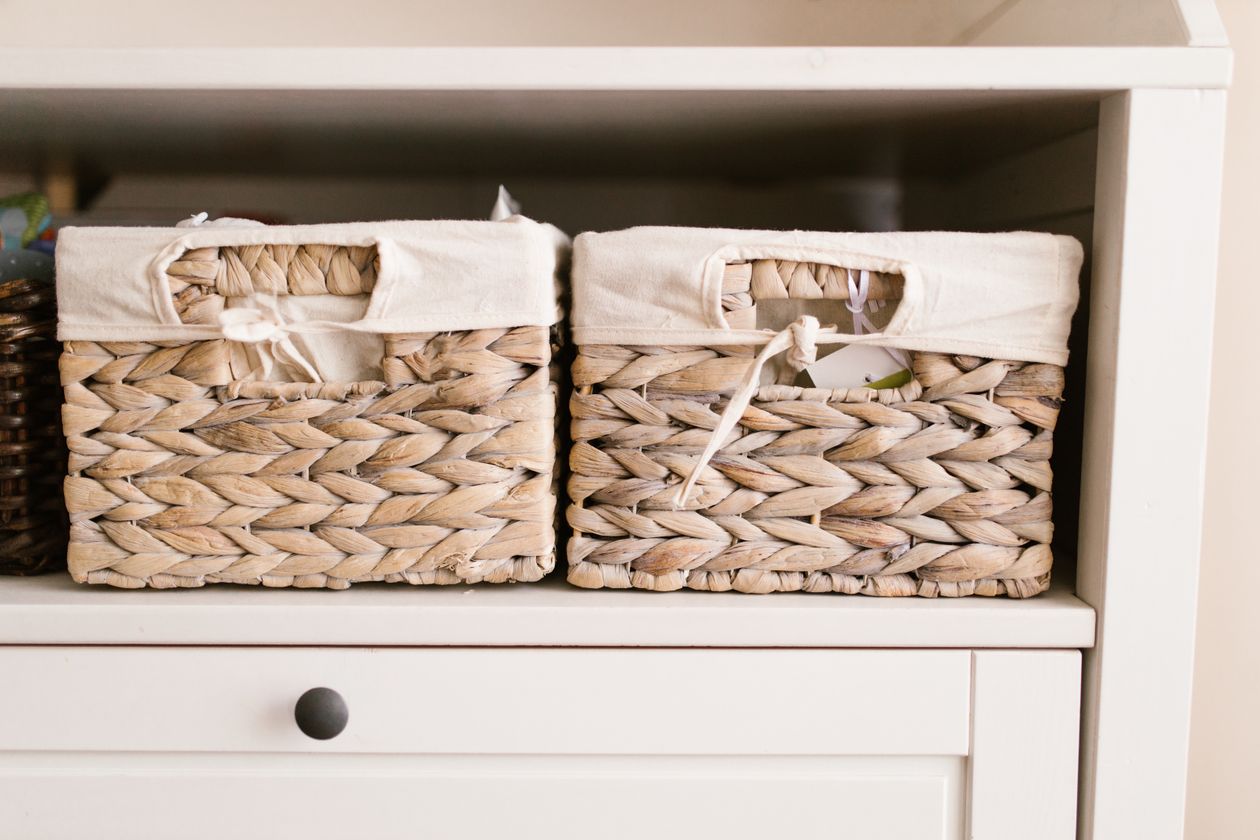
Not every storage solution has to look like a warehouse. I swapped two plastic bins for woven baskets on the eye-level shelf, and the closet suddenly looks intentional instead of industrial. Baskets are great for softer items like washcloths, pillowcases, and the extra throw blankets that never fold neatly.
The handles make them easy to pull down, which matters when the shelf is above my head. One honest warning: woven baskets collect dust in their weave, so I shake them out every couple of months. For the lower shelves where the kids grab things, I still use wipe-clean plastic bins.
Pro Tip: I line my woven baskets with an old pillowcase, so small washcloths do not snag on the weave when I pull the basket down.
Cost: $12–$30 | Time: 20 minutes | Difficulty: Easy
8. Switch to Clear Bins

Clear bins solved the mystery-box problem in my closet. With opaque bins, I opened three wrong ones before finding the flannel sheets in winter. With clear ones, I can see the contents from the hallway, which means I grab the right bin the first time.
They are especially useful for the less-used items like holiday tablecloths and the good guest sheets, because those are the things I forget I own. I still label them, since a clear bin full of folded white fabric all looks the same at a glance, but the combination of seeing and reading beats either one alone.
Pro Tip: I keep my least-used clear bins on the highest shelf, because I can identify them from the floor without climbing up to check.
Cost: $10–$25 | Time: 30 minutes | Difficulty: Easy
9. Vacuum-Seal Seasonal Bedding

Winter comforters and heavy blankets ate an entire shelf in my closet for most of the year. Vacuum-seal bags shrank them to about a third of their size, and suddenly I had room for the everyday linens without cramming.
I seal the off-season bedding, press out the air with a regular vacuum, and slide the flat bags onto the top shelf where they stay until the weather turns. One lesson I learned the hard way: do not vacuum-seal down comforters for more than a season at a time, since long compression can flatten the filling.
For everything else, it is the cheapest space I have ever bought.
Pro Tip: I open a sealed bag the day before I need the bedding, so the filling has time to loft again instead of going straight onto the bed flat.
Cost: $10–$18 | Time: 30 minutes | Difficulty: Easy
10. Declutter First: Linen Closet Organization Begins Empty

I will be honest: the first time I organized this closet, I skipped the decluttering and just bought prettier bins. It looked great for a week and then failed, because the real problem was volume. The second time, I pulled everything out and made three piles: keep, donate, and toss.
I found towels so thin they were basically decorative, a fitted sheet with a torn corner I had been avoiding, and two sets for a bed size we no longer own. Getting rid of those freed an entire shelf before I spent a dollar.
If you do nothing else on this list, do this one — linen closet organization only works when the closet holds things you actually use.
Pro Tip: I sort one shelf at a time into a laundry basket, so the closet is never left completely empty overnight while I decide what stays.
Cost: $0 | Time: 1 hour | Difficulty: Easy
11. Add Sliding Drawers

Deep linen closet shelves have a dark secret: everything at the back is forgotten. I added two sliding drawer units to the bottom of my closet, and they changed how I use the space.
Now the washcloths, pillow protectors, and small items live in drawers I can pull all the way out, instead of in a pile I have to dig through. The drawers also stopped the kids from shoving things to the back and declaring them lost.
Measure your shelf depth before you buy, since a drawer that is even an inch too deep will not slide properly, and leave a little clearance on top so you can lift items out easily.
Pro Tip: I label the drawer fronts with painter’s tape for the first week, until everyone in the house learns where the washcloths and pillow protectors live now.
Cost: $20–$45 | Time: 40 minutes | Difficulty: Moderate
12. Spin Small Essentials on a Turntable
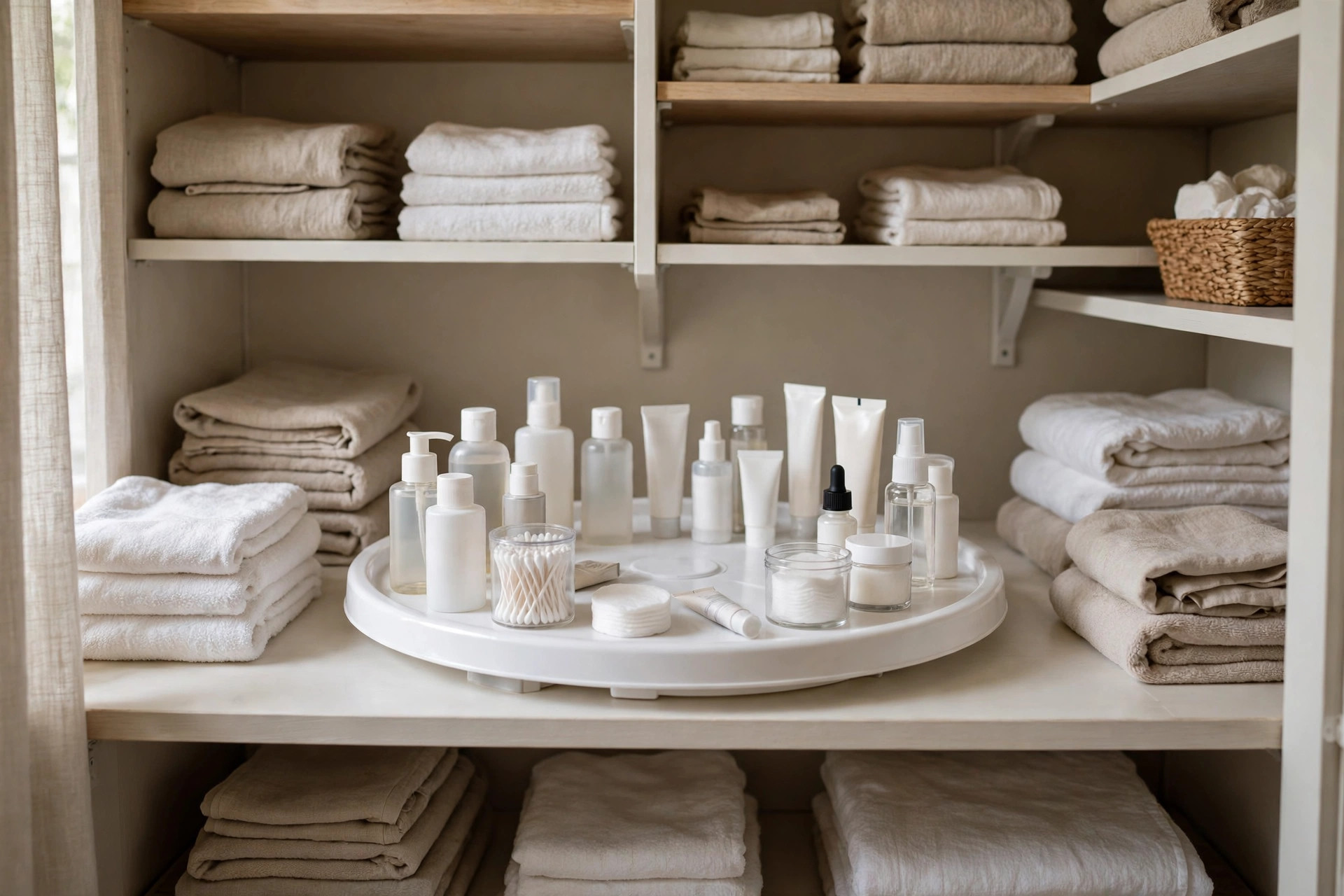
My linen closet had become the unofficial home for random bathroom extras: stain remover, a spare lint roller, sachets, and a bottle of linen spray. They used to hide behind the towel stacks. A small turntable on one shelf corralled them into a single spin, so now I turn it and grab what I need without moving a single towel.
I like a turntable with a low rim so bottles do not slide off when it spins. This is a tiny change, but it stopped the daily annoyance of knocking over a towel stack while reaching for the stain spray before school.
Pro Tip: I keep the stain remover and lint roller facing the front of the turntable, because those are the two bottles I reach for before school and work.
Cost: $8–$15 | Time: 10 minutes | Difficulty: Easy
13. Hang Wall Baskets for Awkward Items

The inside walls of a linen closet are wasted space in most houses, and mine was no exception. I hung two small wall baskets on the side wall for the awkward things that never stack well: the heating pad, a travel pillow, and the spare shower curtain.
Getting those off the shelves freed real room for towels, and the items are actually easier to grab now because they are at eye level instead of buried.
Use proper wall anchors if your closet walls are drywall, since a basket full of blankets is heavier than it looks, and keep the baskets shallow so the door still closes without a fight. A small linen closet is a small-space problem — see small space organization ideas for the general method.
Pro Tip: I loop the heating pad cord over the edge of its wall basket, so it never tangles with the travel pillow stored beside it.
Cost: $10–$22 | Time: 25 minutes | Difficulty: Easy
14. Build Cube Storage

If your linen closet is really just a deep closet with one sad shelf, cube storage can rescue it. I helped a friend set up stackable cubes in her hall closet, and each cube became a category: bath towels, hand towels, sheets, and blankets.
The open fronts mean you can see and reach everything without unstacking, and the cubes are cheap enough to rearrange when your needs change. They work best in wider closets where you can fit two or three across. In a narrow closet, a single column of cubes still beats a tall pile, because nothing ever avalanches onto the floor.
Pro Tip: I leave one cube empty on purpose as a landing spot for clean laundry that still needs sorting, so it never lands on top of a finished stack.
Cost: $25–$60 | Time: 1 hour | Difficulty: Moderate
15. Keep One Label Style

My first labeling attempt was a mess of different label styles: some handwritten, some printed, some on colored tape, all in different sizes. It looked chaotic and actually made the closet harder to read. I redid everything with one single style — same label size, same pen, same wording pattern — and the closet instantly looked calmer and more organized.
Consistency matters more than fanciness here. Pick one label maker or one marker, decide on a format like “Queen — White” or “Guest — Flannel,” and use it everywhere. When everything matches, your eye finds what it needs in seconds instead of scanning a patchwork.
Pro Tip: I store my marker and a few spare labels inside the closet itself, so a new label matches the old ones instead of becoming a one-off.
Cost: $3–$10 | Time: 20 minutes | Difficulty: Easy
16. Store Sets Inside Their Pillowcase

This is the oldest trick in the book and it still works beautifully. Fold the fitted sheet, flat sheet, and one pillowcase into a neat bundle, then slip the whole set inside the second pillowcase. The set stays together forever, no more hunting for the matching pillowcase while the bed sits half-made.
I do this for every set in the house now, and bed-changing day got noticeably faster. It also makes the stacks look uniform, since every bundle is roughly the same size and shape. The only sets I skip are the ones with decorative shams, which I store flat on top of the bundle instead.
Pro Tip: I fold the open end of the pillowcase underneath the bundle, so the set does not unravel when I slide it off the shelf.
Cost: $0 | Time: 15 minutes | Difficulty: Easy
17. Reserve the Top Shelf for Guests
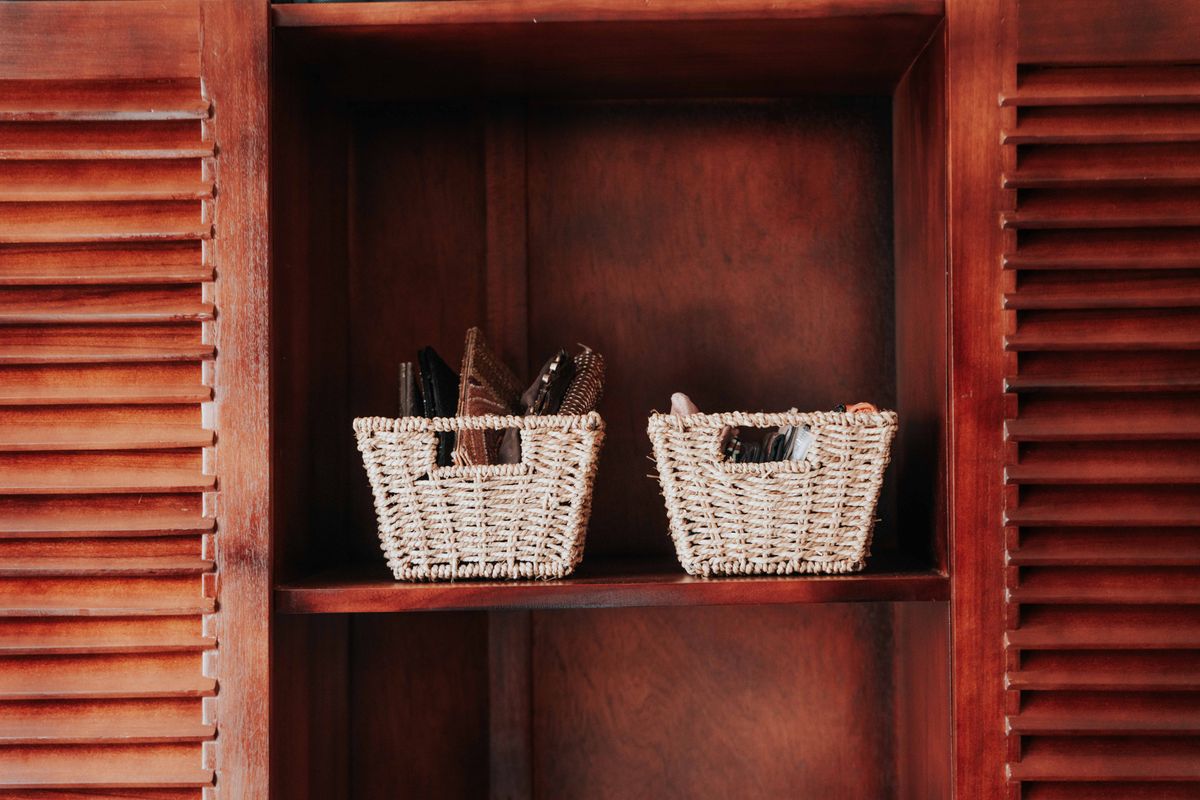
Guest linens used to get mixed in with our everyday stuff, which meant guests sometimes got a faded towel while we kept the good ones. I moved all the guest bedding to the top shelf in one labeled basket: two complete sets, two good towels, and a washcloth each.
When someone visits, I grab one basket and the guest room is done. Keeping guest items separate also protects them from daily wear, so they actually look nice when they come out. If your top shelf is hard to reach, a small step stool kept nearby makes this system painless instead of annoying.
Pro Tip: I drop a washcloth per guest into the basket the night before they arrive, so I am not opening and rearranging it twice on the morning they come.
Cost: $0–$12 | Time: 20 minutes | Difficulty: Easy
18. Keep a Washcloth Basket Within Reach

Washcloths are small, but they caused outsized chaos in my closet because they slipped between stacks and vanished. I gave them their own small basket on the lowest shelf, right where hands naturally reach, and the problem disappeared. I roll them instead of folding, which lets me fit about twenty in a basket the size of a shoebox.
The kids can grab one without disturbing anything else, and I can see instantly when we are running low. This is one of those ideas that sounds too simple to matter, but it removed a daily friction point I had just accepted as normal.
Pro Tip: I count the washcloths when I put the basket back after laundry, so I know we are running low before the morning rush proves it.
Cost: $5–$12 | Time: 10 minutes | Difficulty: Easy
19. Freshen the Closet Naturally

An organized closet that smells musty is only half a win. I tuck a couple of lavender sachets between the towel stacks and a small open box of baking soda on the back of a shelf, and the closet smells fresh every time I open it.
I avoid heavy plug-in fragrances in a closed closet, since the scent soaks into the towels and then into your skin. Cedar blocks work well too, especially for the wool blankets, and they help keep moths away.
Replace the sachets every few months, or refresh them with a drop of essential oil, and the whole closet stays inviting instead of stale.
Pro Tip: I tuck sachets between the middle stacks rather than only on top, so the towels I actually reach for first carry the fresh scent.
Cost: $3–$8 | Time: 10 minutes | Difficulty: Easy
20. Do a Five-Minute Weekly Reset

Here is the unglamorous truth: no organizing system survives without maintenance, but maintenance does not have to be a project. Every Sunday, while the laundry runs, I spend five minutes in the linen closet: refold one leaning stack, return anything that migrated to the wrong bin, and toss any towel that has finally given up. That is it.
Five minutes a week has kept my closet looking like the day I organized it for over a year now, while the previous version fell apart in a month. Put it on the same day you change the beds, and it becomes a habit instead of a chore.
If you want a similar system for the rest of the house, my utility closet organization ideas use the same weekly-reset trick.
Pro Tip: I keep a small bag in the closet during my weekly reset for towels that have finally given up, so they leave with me instead of returning to the shelf.
Cost: $0 | Time: 5 minutes weekly | Difficulty: Easy
Linen Closet Organization Methods Compared
| Method | Best For | Typical Cost | Upkeep |
|---|---|---|---|
| Bins by bed | Keeping sheet sets together | $8–$20 | Low |
| Rolling towels | Small closets, visual calm | $0 | Low |
| Shelf dividers | Stopping stack avalanches | $10–$25 | Very low |
| Vacuum bags | Seasonal bedding | $10–$18 | Seasonal |
| Labels | Finding the right set fast | $3–$10 | Very low |
| Cube storage | Deep or wide closets | $25–$60 | Low |
Mistakes I Made
Buying bins before decluttering. My first attempt looked great on Instagram and failed within weeks, because I had organized clutter instead of removing it. Now I always declutter first, then measure, then buy.
Stacking too high. I used to build towel towers twelve high because it looked tidy. In practice, anything above eight towels topples when you pull from the middle. Shorter stacks and dividers fixed it.
Forgetting the door swing. I once mounted a basket on the closet door that blocked it from closing. Measure the clearance before you hang anything on a door or wall near it.
Mixing guest and everyday linens. Guests kept getting our oldest towels because everything lived together. A separate guest basket ended that embarrassment for good.
Frequently Asked Questions
How many sheet sets should I keep per bed?
Two sets per bed is the sweet spot for most homes: one on the bed, one in the closet. A third set makes sense for kids’ beds or allergy seasons, but more than that usually just creates clutter.
Is it better to roll or fold towels?
Rolling saves space and prevents stacks from toppling, which makes it ideal for small closets and baskets. Folding looks neater for thick, heavy towels and for open shelves where you want a uniform look. I roll everyday towels and fold the bulky ones.
How do I keep my linen closet smelling fresh?
Start with completely dry linens, since dampness causes most musty smells. Then add lavender sachets or cedar blocks, and keep a small open box of baking soda on a back shelf to absorb odors.
What is the best way to store a fitted sheet?
Fold it into a flat rectangle by tucking the elastic corners into each other, then fold it into a bundle and slip it inside one of its pillowcases with the rest of the set. It stays together and stacks neatly.
How often should I declutter my linen closet?
A quick check every season is enough for most homes. Pull out anything stained, torn, or unused for a year, and you will keep the closet from slowly refilling with things you do not need.
Final Thoughts
A calm linen closet will not change your life, but it will change your mornings, and mornings matter. Start with the declutter, pick two or three ideas from this list that fit your space and budget, and give the system a month before you judge it.
Mine took one Saturday to build and five minutes a week to keep, and I have never gone back to the leaning tower. If you are on a tight budget, my dollar store closet organization ideas show how to get bins, baskets, and labels for very little money. Bins and dividers do not need to be expensive — see dollar store organization hacks for the budget versions.
Happy organizing, and may your fitted sheets always match on the first try.





3 Comments